
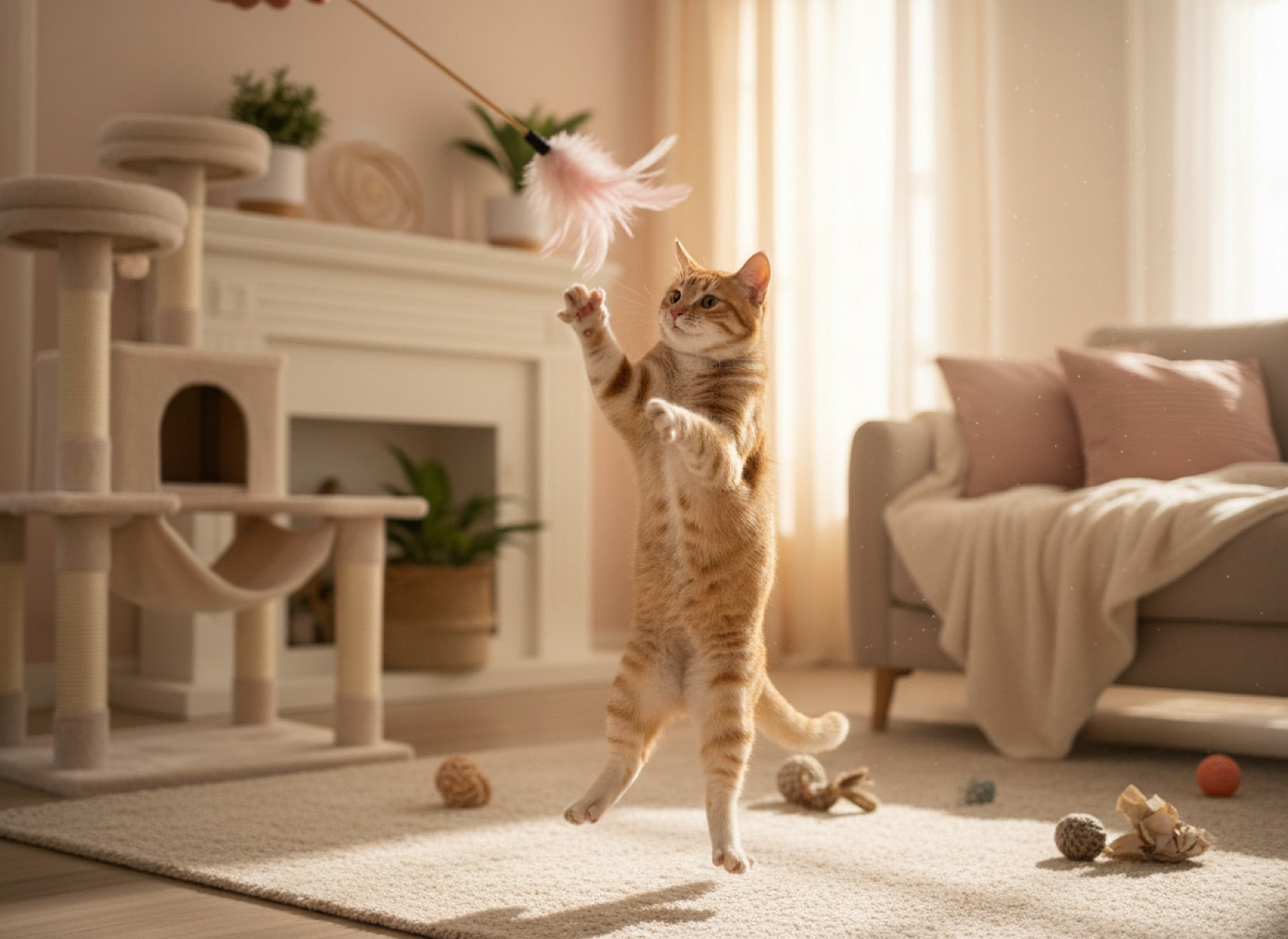


A cat tree or a scratching post answers a natural cat need: sharpening claws, stretching, watching over its territory from up high, and having a space that belongs to it. The right choice mostly depends on the space available at home, the number of cats and their habits, more than on any single universal model.
1. Why scratching is a need, not a whim
Scratching is not meant to damage furniture: it is a natural behaviour that lets a cat maintain its claws, mark its territory through pheromones in its paw pads, and stretch its spine. A cat without a suitable scratcher will almost always turn to a sofa, a rug or a piece of furniture, not out of mischief but because the need is still there, whether or not a proper option is offered. Understanding this changes how to approach the problem: the goal is not to stop the cat from scratching, but to offer it a surface it will spontaneously prefer over your sofa.
2. Simple scratcher or a full cat tree
- A scratching post, vertical or angled, is often enough for a cat that mainly needs to sharpen its claws. A 60 cm scratching post allows a full body stretch, more satisfying for the cat than a shorter model.
- A floor scratcher or decorative-object style scratcher, like a plant-shaped scratcher, suits cats that prefer scratching horizontally or homes looking for a more discreet solution.
- A full cat tree, with several platforms, hideaways and built-in scratchers, meets several needs at once: perching up high, hiding, watching, and scratching, especially useful in a multi-cat home or for a cat left alone part of the day.
3. Criteria for choosing a good cat tree
- Stability: a cat tree that wobbles or shakes at the top will discourage the cat from using it, or even scare it after a bad experience. Check the base width relative to the total height.
- Height: the taller the tree, the better the vantage point it offers, something cats appreciate, especially in homes with several pets where height allows them to get some distance.
- Number of levels and hideaways: useful in a multi-cat home, so each cat has its own space without rivalry.
- Material of the built-in scratcher: sisal remains the reference, sturdy and satisfying under the claws, far more durable than cardboard alone over time.
- Maintenance: a plush covering traps more fur than a wood or sisal covering, worth considering if you have a cat that sheds a lot.
For a home with some space, a wooden cat tree with a hideaway and cushions combines comfort and sturdiness. For a multi-cat home, a model like the cat tree with hideaway and blanket offers several separate resting spaces.
4. Where to place the cat tree or scratcher
Placement strongly influences how the cat will use it:
- Near a window, a cat tree also becomes a lookout point onto the outside, a favourite for most cats.
- Near an entrance or a busy spot, a scratcher often catches the cat's attention right when it heads towards a piece of furniture to scratch, making it easier to redirect the behaviour.
- Avoid an isolated, rarely visited corner: a cat rarely chooses to settle there on its own, even with good quality furniture.
- For a kitten just discovering its territory, placing the tree or scratcher in a shared living room speeds up learning, since it also watches how other cats in the home use it.
5. What to do if the cat keeps scratching furniture
A few simple adjustments often help redirect the behaviour:
- Place the scratcher or cat tree right in front of the targeted piece of furniture while the habit changes, before gradually moving it to its permanent spot.
- Reward the cat with a treat or a cuddle when it spontaneously uses the scratcher.
- Avoid scolding a cat for scratching furniture: it will not understand the cause and effect, and this can simply create anxiety without solving the problem.
- A floor scratching mat is an easy add-on solution to place in several rooms of the house.
6. How many scratchers should you have?
In a single-cat home, a vertical scratcher paired with a horizontal one usually covers the two most common scratching positions. In a multi-cat home, it is better to add more scratching spots rather than relying on a single large cat tree: this reduces situations where a more assertive cat monopolises the only available spot and stops the others from accessing it freely. Spreading scratchers across different rooms, rather than grouping them in one spot, also encourages each cat to claim its own corner.
7. Browse all our cat trees and scratchers
Discover all the models, cat trees and scratchers alike, gathered in the cat trees and scratchers collection.
Is your cat shedding a lot of fur? Read our article on how to brush it and which tools to choose to limit fur around its cat tree.


Leave a comment
This site is protected by hCaptcha and the hCaptcha Privacy Policy and Terms of Service apply.